United States and Saudi Arabia Strike Iraq Days Before Arbaeen

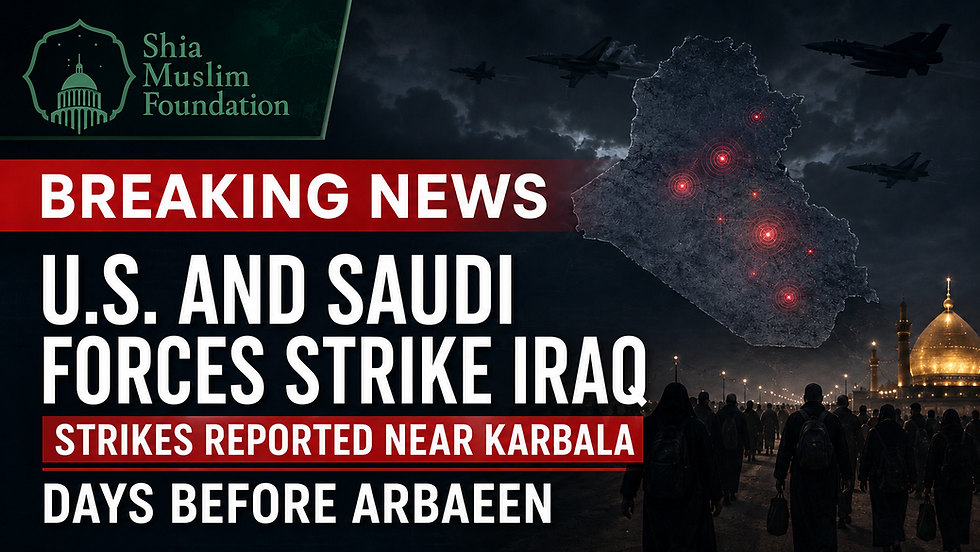
At least 20 Iraqi personnel killed as millions of worshippers travel toward Karbala
The United States and Saudi Arabia conducted joint airstrikes across Iraq overnight Tuesday, killing at least 20 members of Iraq’s Popular Mobilization Forces and wounding 32 others. The attacks occurred as millions of civilian worshippers travel toward Karbala for Arbaeen, which falls on Tuesday, August 4, 2026.
United States Central Command confirmed that American and Saudi fighter aircraft struck weapons and logistics facilities on July 28. The Popular Mobilization Forces reported attacks in Baghdad, Wasit, Nineveh, Basra, Kirkuk, Karbala, and Diyala. The PMF, commonly known as the Hashd al Shaabi, operates as an official component of Iraq’s state security system.
According to the PMF, the attacks killed at least 20 personnel and wounded 32. The organization described the figures as preliminary and reported damage to buildings, vehicles, equipment, and other property.
The deadliest publicly documented attack occurred in the Nineveh Plain at approximately 3:20 a.m. Wednesday. The Nineveh PMF command said seven airstrikes hit the headquarters of the Fourth Regiment of Brigade 30 and a facility operated by the Directorate of Anti Armor Fighters. Eight Brigade 30 personnel and two Anti Armor Directorate personnel were killed. Six others were wounded.
The Nineveh command called the operation “a highly dangerous escalation” and “a violation of Iraq’s sovereignty.”
A separate strike hit the PMF Operations Command headquarters in Basra, wounding two personnel. Iraqi authorities have not released complete information about the individual sites struck in Baghdad, Wasit, Kirkuk, Karbala, or Diyala.
United States and Saudi Arabia acknowledge responsibility
Responsibility for the airstrikes is confirmed. United States Central Command said American and Saudi forces conducted the operation together.
“United States and Saudi fighter aircraft struck multiple terrorist logistics and weapons sites across eastern Iraq,” CENTCOM said in its official statement.
The command said the operation answered more than 30 drone attacks allegedly directed by Iran’s Islamic Revolutionary Guard Corps during the preceding 72 hours. It accused armed groups in Iraq of targeting American forces and Saudi energy infrastructure.
“The IRGC and its terrorist proxies must cease these attacks to avoid further United States military response,” CENTCOM said.
Saudi Arabia’s Defense Ministry separately acknowledged Saudi participation.
Major General Turki al Malki, the ministry’s official military spokesperson, said drones targeting Saudi petroleum facilities had come from Iraqi territory. He accused armed groups supported by Iran of conducting the attempted attacks.
Al Malki said Saudi Arabia reserved the right to respond “at the appropriate time and place.”
He also said the kingdom had an inherent right to defend its territory and national assets. Following the airstrikes, the Saudi Defense Ministry said the kingdom did not seek further escalation but would respond to any attack against it.
Allegations remain disputed
Iran denied directing attacks against Saudi Arabia. An Iranian military official described the accusations as a “major miscalculation.”
The Islamic Resistance in Iraq also denied responsibility for the drone attacks and called the Saudi claims fabricated. Neither Washington nor Riyadh has publicly released evidence identifying the Iraqi units that allegedly launched the drones.
Iraqi Prime Minister Ali al Zaidi had ordered an investigation into the alleged drone launches before the airstrikes occurred. Iraq said it would not permit its territory to be used for attacks against neighboring countries.
The identity of the countries that conducted the airstrikes is therefore confirmed. The allegation that the specific PMF personnel and facilities struck were responsible for the preceding drone attacks remains contested.
Iraq condemns violation of its sovereignty
The Iraqi presidency condemned the attacks as an unacceptable violation of Iraqi sovereignty and an assault on official state security institutions. The presidency called on all parties to respect Iraq’s sovereignty and refrain from actions that could threaten its security and stability. The prime minister called an emergency meeting of the Ministerial Council for National Security.
President Donald Trump reportedly said the operation was coordinated with the Iraqi government. Iraqi officials have not publicly confirmed approving the strikes. The Iraqi government’s condemnation raises questions about the nature of any claimed coordination.
No individual American military commander has publicly addressed the civilian implications of conducting strikes across Iraq during the Arbaeen pilgrimage. The American military response has so far come through CENTCOM’s institutional statement.
Arbaeen pilgrims enter an expanding conflict zone
The attacks come during the final days before Arbaeen, one of the largest annual religious gatherings on earth. Arbaeen takes place on the twentieth day of Safar and marks forty days since the martyrdom of Imam Husain (AS), the grandson of the Prophet Muhammad, at the Battle of Karbala in 680. Iraqi religious authorities have placed this year’s observance on Tuesday, August 4, 2026. Pilgrims are already walking toward Karbala from Basra, Najaf, Baghdad, and other parts of Iraq. Others are entering through Iraqi airports and land crossings.
These innocent worshippers include families, children, elderly visitors, religious students, volunteers, and people with disabilities. They come from Iraq, Iran, India, Pakistan, Afghanistan, Lebanon, the Gulf states, Africa, Europe, North America, and other regions. Iraqi figures show the international scale of the gathering. In 2025, more than 4.1 million foreign pilgrims from 140 countries entered Iraq for Arbaeen. Total attendance in Karbala exceeded 21 million.
More than 1.27 million foreign pilgrims had already entered Iraq during the current religious season by July 25, according to Iraqi security officials.
Volunteers operate thousands of roadside service stations that provide pilgrims with free meals, water, medical care, transportation, and places to rest. UNESCO recognizes this tradition of service and hospitality as part of humanity’s intangible cultural heritage.
One of the provinces struck was Karbala, the destination of the pilgrimage. Other affected provinces sit along routes used by worshippers traveling toward the holy city.
There is no verified evidence that the latest airstrikes deliberately targeted pilgrims or that Arbaeen worshippers were among the casualties. However, conducting military operations across several Iraqi provinces during the pilgrimage creates a serious risk of civilian harm, panic, disrupted transportation, and further escalation.
Arbaeen pilgrims are peaceful civilians participating in a religious observance with a history stretching back more than a thousand years. Governments and armed forces involved in the conflict bear responsibility for protecting worshippers and keeping pilgrimage routes, border crossings, airports, service stations, religious sites, and civilian gathering areas away from military operations.
Sources
United States Central Command: https://www.centcom.mil/MEDIA/PUBLIC-RELEASES/Article/4558191/us-saudi-forces-strike-iran-backed-terrorist-sites-in-iraq/
Reuters on the strikes and Iraqi response: https://www.reuters.com/world/asia-pacific/us-saudis-attack-iran-backed-groups-iraq-threatening-intensify-conflict-2026-07-29/
Reuters on the Saudi account: https://www.reuters.com/world/middle-east/saudi-arabia-says-drones-launched-iraq-targeting-oil-facilities-intercepted-2026-07-28/
National Iraqi News Agency: https://ninanews.com/website/News/Details?key=1307903
Iraqi Arbaeen participation figures: https://imamhussain.gov.iq/index.php/english/47012
UNESCO on Arbaeen service and hospitality: https://ich.unesco.org/en/RL/provision-of-services-and-hospitality-during-the-arba-in-visitation-01474

Comments