Faith, Stigma and Seeking Help: What the Data Says About Muslim Americans' Mental Health


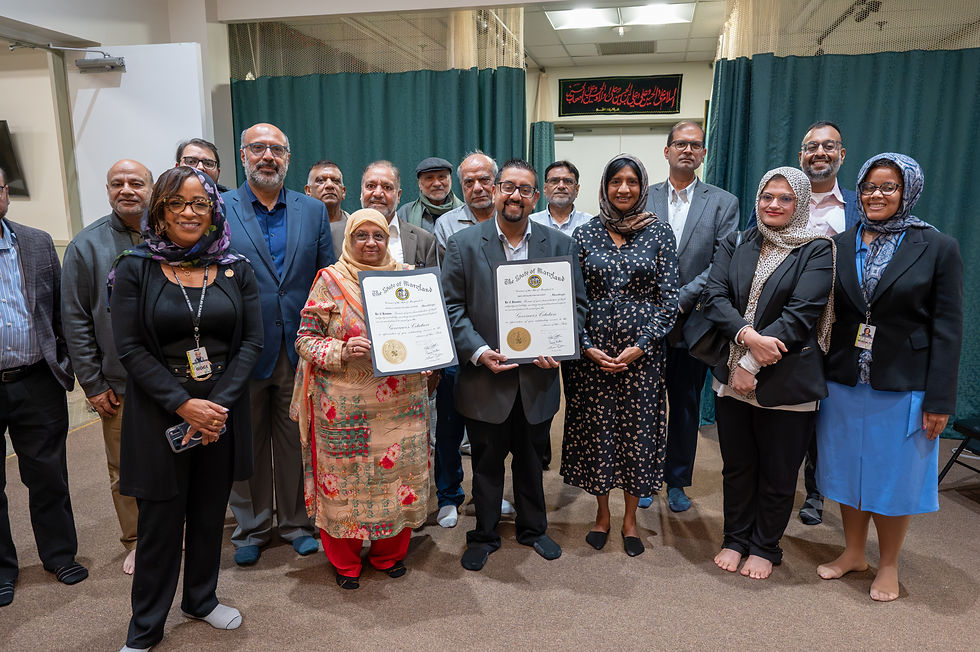
BURTONSVILLE, Md. — When Lt. Gov. Aruna Miller and state Sen. Clarence K. Lam came to Idara e Jaferia on October 17, the State of Maryland honored the Shia Muslim Foundation (SMF) and Idara e Jaferia for a workshop on a subject many families still find hard to talk about: mental health. Read SMF's report on the Governor's Citations and the General Assembly proclamation.
The honors recognized one morning's conversation. The questions behind it are bigger. How are Muslim Americans really doing? Why do so many hesitate to see a counselor? And what can mosques, community centers and the state do about it? This SMF News deep dive looks at what the research says, and where families can turn for help.
What the latest numbers show
The most recent national data comes from the Institute for Social Policy and Understanding (ISPU). Its May 2026 analysis, Distress and Disconnection, draws on the American Muslim Poll 2025. It found a mixed picture. Slightly more than half of Muslims (53%) rate their mental health as "excellent" or "very good," on par with 52% of the general public.
But more than one in five Muslims (22%) rate their mental health as "fair" or "poor," compared with 18% of the general public, ISPU reported. The gaps are wider inside the community. Muslim women were more likely than Muslim men to report fair or poor mental health (29% vs. 17%). Young adults had the hardest time: 33% of Muslims ages 18 to 29 rated their mental health fair or poor, about twice the rate of Muslims 30 to 49 (15%) and 50 and older (17%).
Pressures that add up
ISPU points to a set of factors that put Muslim Americans at higher risk of chronic stress. Muslims are younger than other faith groups, with about a quarter of Muslim adults between 18 and 29, compared with 5% to 15% of other groups. About 35% of Muslim households earn $30,000 or less a year, the highest share of any religious group surveyed, and 40% of Muslims in the U.S. were born outside the country, according to the report.
Discrimination is part of the picture too. In the American Muslim Poll 2025, 63% of Muslims said they had faced religious discrimination in the past year, more than any other faith group surveyed. ISPU notes that research has shown Islamophobia to be a structural determinant of mental health for Muslims in the United States.
For Shia Muslim families, the October workshop named these pressures directly: coping with tragedy, discrimination and stress, including grief over suffering abroad, as SMF reported.
Where people turn first: faith, family and the imam
Many Muslims look first to faith and family when they are struggling. ISPU's earlier study of Muslims during the pandemic found they reported similar levels of mental distress as the general public, but were more likely to rely on faith and family to cope rather than professional treatment.
The new data shows a gap in professional care, and also progress. Just 32% of Muslims said they had ever visited a mental health professional, compared with 38% of the general public. That number has grown, though, from 25% in 2019, ISPU found. And Muslim parents were just as likely as other parents to report a child under 18 who has received mental health treatment (11%, compared with 13% of the general public).
That leaves faith leaders carrying a heavy load. In a national survey of imams published in Psychiatric Services, researchers mailed questionnaires to 730 mosques across the United States. Imams reported that congregants came to them most often for religious or spiritual guidance and for relationship or marital concerns, and that since September 11, 2001, they had seen an increased need to counsel people who faced discrimination. Few of the responding imams had formal counseling training.

The authors concluded that imams need more support from mental health professionals to fulfill "a potentially vital role in improving access to services" for Muslim communities with unmet needs.
Bringing care into community spaces
Researchers increasingly say the answer is not to choose between faith and treatment, but to bring them together. ISPU recommends that Muslim community leaders partner with mental health professionals for education, make local resources easier to find, and consider offering mental health services directly in mosques and community centers. It points to the Islamic Center of Detroit, which launched My Mental Wellness Clinic to make care visible, accessible and affordable, and cites a study finding that integrating Muslim mental health professionals into the mosque community "can help normalize the use of these services and increase their accessibility."
ISPU also urges mental health professionals to build religious literacy and to offer practical accommodations: gender-matched providers, virtual appointments, evening and weekend hours, and private spaces for prayer.

The Burtonsville workshop followed that model. It put Maryland's Deputy Secretary for Behavioral Health, Dr. Rachel Talley, and the Governor's Office of Community Initiatives' Director of Faith Outreach, Dr. Lora Hargrove, alongside psychiatrists Dr. Syed Akhtar Naqvi, Dr. Mahvash Sheikh and Dr. Fezan Rizvi, inside a Shia Muslim center. Speakers stressed that stigma can keep people from seeking treatment, and Dr. Hargrove noted that interest in holistic wellness can open the door to conversations about mental health, SMF reported.
Maryland's growing role
Maryland has made faith communities part of its approach. Lt. Gov. Miller's policy portfolio includes mental health, and she chairs Maryland's first Council on Interfaith Outreach, which brings together faith leaders from across religions and across the state to "bridge divides, increase religious tolerance, end hate, and better serve all communities," according to her office.
The Governor's Office of Community Initiatives says its faith outreach connects faith-based organizations with resources from state and federal agencies, including grants, through partnerships, workshops, conferences and other events. Its work covers issues including emergency and disaster preparedness and threats and vulnerabilities facing faith organizations.
The state's crisis line is also growing. Maryland 988 received 157,712 contacts in 2025, a 27% increase from the year before, and Maryland call specialists answer nearly all calls (92%), according to the Maryland Department of Health. The department's Behavioral Health Administration oversees and funds the service through eight regional call centers. Citing research published in JAMA, the department says 988 has been linked to an 11% decrease in suicides nationwide among people ages 15 to 34 since it launched in July 2022.
Where to find help
Anyone in emotional distress, or worried about someone else, can call or text 988 or chat at chat.988lifeline.org. The 988 Suicide & Crisis Lifeline is free, confidential and available 24/7. It is not only for suicidal crises. The federal Substance Abuse and Mental Health Services Administration (SAMHSA) lists anxiety, depression, loneliness, trauma, bullying, stress and relationship troubles among the reasons people reach out.

Callers do not have to give personal information to get support, and interpretation is available in more than 240 languages, which matters for immigrant families and elders, SAMHSA says. If someone is in immediate danger, call 911. Maryland's 988 page also links to mental health and substance use services across the state.
For faith-sensitive care, ISPU's mental health toolkit points to the Institute for Muslim Mental Health's directory of Muslim mental health professionals. ISPU also lists American Muslim Health Professionals, The Family and Youth Institute, Maristan and Stanford's Muslim Mental Health & Islamic Psychology Lab as resources.
Why it matters
The data points in one direction. Muslim Americans, especially young adults and women, carry real strain, and many still turn first to faith and family rather than to a professional. That makes mosques and community centers natural front doors to care. When those doors open onto clinicians, state health leaders and resources like 988, as they did in Burtonsville on October 17, families have more places to turn.
Read SMF's original report: Maryland Honors Idara e Jaferia and Shia Muslim Foundation at Faith and Mental Health Workshop. For the full program, see SMF's workshop recap.
Sources: ISPU, Distress and Disconnection (May 4, 2026); ISPU, American Muslim Poll 2025; ISPU Mental Health Toolkit; Ali, Milstein and Marzuk, Psychiatric Services (2005); Office of Lt. Gov. Aruna Miller; Governor's Office of Community Initiatives, Faith Outreach; Maryland Department of Health, 988 Lifeline Overview (June 2026); SAMHSA, 988 FAQs. Photos: Shia Muslim Foundation.
Comments